
2.24.26 When Mega Caps Waver and Small Caps Surge
Every market cycle has its own character, but certain patterns appear frequently enough that they deserve attention. This is especially true when evaluating early-year rallies in small caps. Market history offers several notable examples of small caps surging right at the start of the year, and these bursts of strength have often provided insight into where we stand in the broader cycle.
One example comes from January 1972, during the rise of the “Nifty Fifty”, when small caps rose more than 10% in a single month and finished the first quarter up nearly 19%. Another example occurred in January and February 2000, a period when small caps posted a strong advance right out of the gates even as the overall market had become dominated by large cap technology names. In both cases, the early surge did not mark the beginning of a new small cap cycle. Instead, it represented a temporary spark within an already mature bull market.
When markets reach high levels of concentration, as they have today, it is not uncommon to see short-lived phases where small caps and other lagging market segments finally attract interest. However, history suggests that sustained broadening after periods of elevated concentration usually does not take hold until after the market has moved through a phase of meaningful volatility. The 1972 episode illustrates this well. By the end of that year, small caps had surrendered most of their first quarter gains and ended the year with a return of less than 5%. They then declined broadly during the severe 1973–1974 bear market before eventually emerging as market leaders and embarking on one of the strongest periods of small cap outperformance ever witnessed over the next five years.
We do not want to understate the importance of the strength we have seen in small caps this year. Broadening can obviously be a healthy development for the market. Even so, it is also essential to consider context. Sharp early year rallies in small caps during periods of elevated index concentration tend to occur when the cycle is already well advanced and when the market is wrestling with its own internal imbalances.
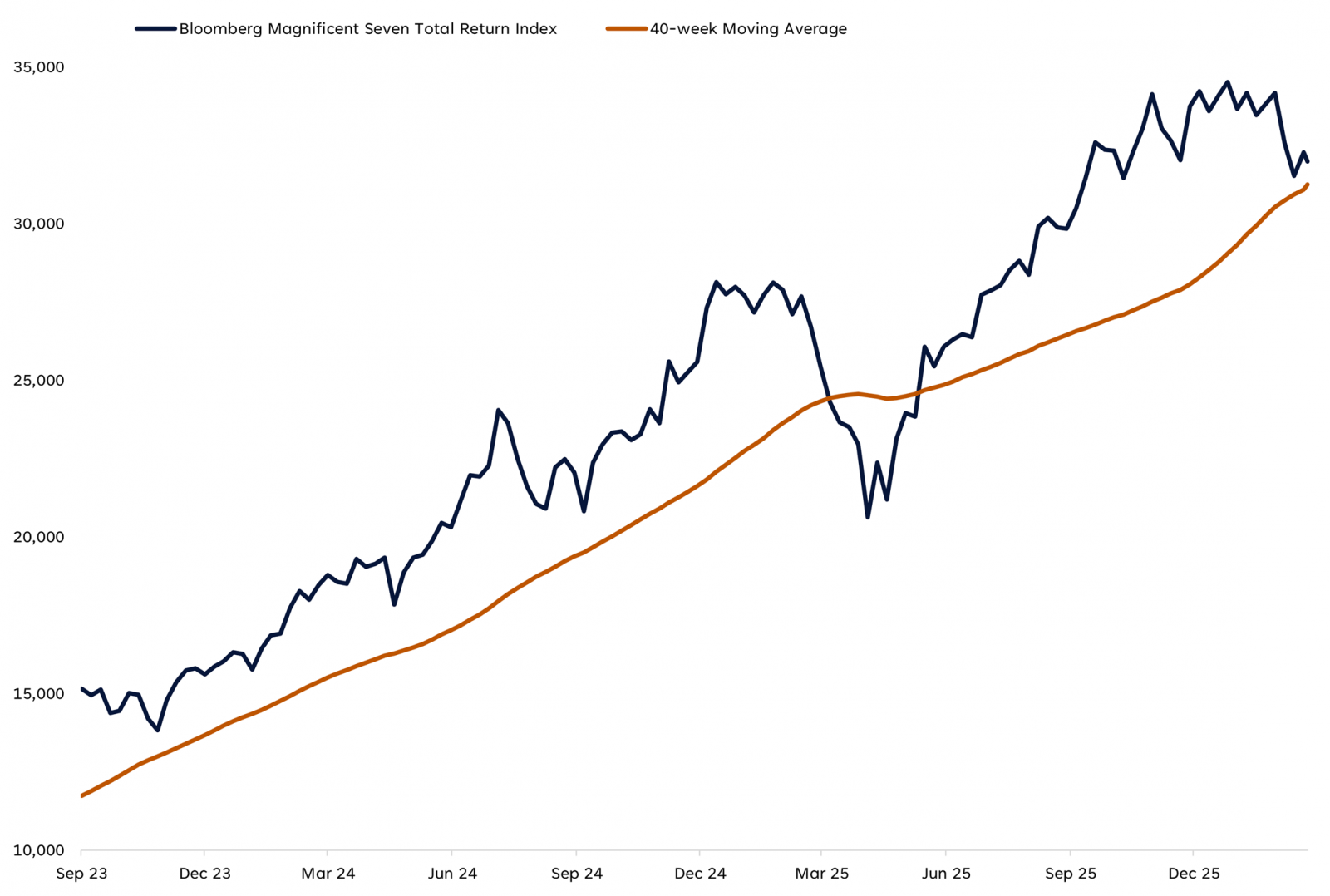
With the Magnificent Seven pulling back into a major area of support last week, as highlighted in the “Magnificent Seven Attempting to Hold Major Support Level” chart, the market now appears to be at an important inflection point. How prices behave over the next several weeks could provide meaningful insight into the market’s true condition and the likely direction of leadership. If the megacaps are going to re-establish themselves as the dominant drivers of performance again, this is the type of technical and seasonal backdrop in which such a transition would be expected to emerge. However, if that leadership does not reassert itself here, it will be a strong sign that the character of the market is indeed undergoing a more important shift, which could bring with it a higher degree of overall market volatility.
Magnificent Seven Attempting to Hold Major Support Level
- Source: LPL Research, Bloomberg 02/23/26
- Disclosures: All indexes are unmanaged and cannot be invested in directly. Past performance is no guarantee of future results.
- Important Disclosures
- This material is for general information only and is not intended to provide specific advice or recommendations for any individual. There is no assurance that the views or strategies discussed are suitable for all investors. To determine which investment(s) may be appropriate for you, please consult your financial professional prior to investing.
- Investing involves risks including possible loss of principal. No investment strategy or risk management technique can guarantee return or eliminate risk.
- Indexes are unmanaged and cannot be invested into directly. Index performance is not indicative of the performance of any investment and does not reflect fees, expenses, or sales charges. All performance referenced is historical and is no guarantee of future results.
- This material was prepared by LPL Financial, LLC. All information is believed to be from reliable sources; however LPL Financial makes no representation as to its completeness or accuracy.
- Unless otherwise stated LPL Financial and the third party persons and firms mentioned are not affiliates of each other and make no representation with respect to each other. Any company names noted herein are for educational purposes only and not an indication of trading intent or a solicitation of their products or services.
- Asset Class Disclosures –
- International investing involves special risks such as currency fluctuation and political instability and may not be suitable for all investors. These risks are often heightened for investments in emerging markets.
- Bonds are subject to market and interest rate risk if sold prior to maturity.
- Municipal bonds are subject and market and interest rate risk and potentially capital gains tax if sold prior to maturity. Interest income may be subject to the alternative minimum tax. Municipal bonds are federally tax-free but other state and local taxes may apply.
- Preferred stock dividends are paid at the discretion of the issuing company. Preferred stocks are subject to interest rate and credit risk. They may be subject to a call features.
- Alternative investments may not be suitable for all investors and involve special risks such as leveraging the investment, potential adverse market forces, regulatory changes and potentially illiquidity. The strategies employed in the management of alternative investments may accelerate the velocity of potential losses.
- Mortgage backed securities are subject to credit, default, prepayment, extension, market and interest rate risk.
- High yield/junk bonds (grade BB or below) are below investment grade securities, and are subject to higher interest rate, credit, and liquidity risks than those graded BBB and above. They generally should be part of a diversified portfolio for sophisticated investors.
- Precious metal investing involves greater fluctuation and potential for losses.
- The fast price swings of commodities will result in significant volatility in an investor's holdings.
- This research material has been prepared by LPL Financial LLC.
- Not Insured by FDIC/NCUA or Any Other Government Agency | Not Bank/Credit Union Deposits or Obligations | Not Bank/Credit Union Guaranteed | May Lose Value
- For Public Use – Tracking: #1068958
Contact us directly should you have questions about this topic.