
7.8.26 What AI’s Next Act Might Look Like
LPL’s Midyear Outlook 2026 has arrived. While much of the report provides the types of content you might expect from LPL Research, such as forecasts for GDP, earnings, and interest rates, this edition of the publication is unique in its focus on four key themes that we believe will shape capital markets performance in the second half. Here we focus on one of those themes: AI’s Next Act.
Evolving AI Narrative
AI is likely to remain a key driver of equity markets during the second half of 2026, but the narrative is evolving. The market is shifting from enthusiasm over AI infrastructure spending and rapid earnings growth toward a more balanced debate about returns on investment and which companies will ultimately benefit most.
Still, the scale of AI investment remains extraordinary. Alphabet (GOOG/L), Amazon (AMZN), Meta (META), Microsoft (MSFT), and Oracle (ORCL) are collectively on track to spend more than $750 billion on AI infrastructure in 2026, with spending potentially exceeding $1 trillion in 2027. This buildout has fueled exceptional earnings growth, particularly in technology and semiconductors. At the same time, AI adoption remains relatively early, suggesting significant productivity benefits may still lie ahead as usage broadens across industries.
Hyperscaler Capital Expenditures Continue to Rise
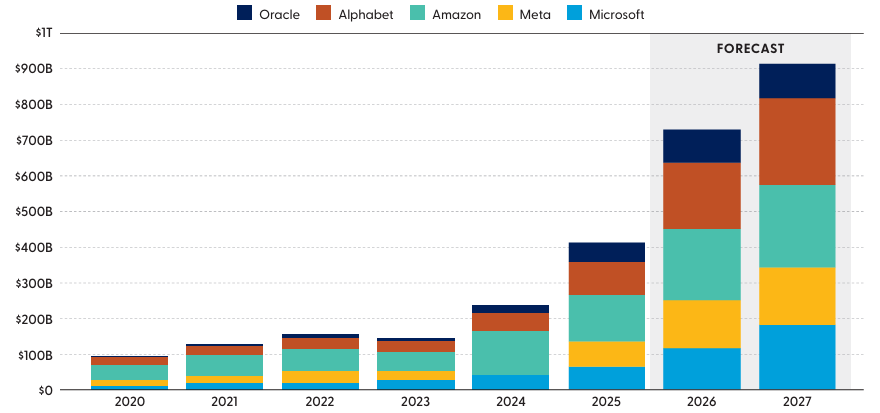
- Source: LPL Research, Bloomberg 06/30/26
- Disclosure: Oracle’s fiscal year ends May 31. All other companies report on a calendar year basis. Estimates may not materialize as predicted and are subject to change.
Despite investor concerns that the AI investment cycle could be nearing a peak, several factors suggest the buildout may have further runway. Major AI leaders continue to signal higher spending plans, and constraints related to data center capacity, power availability, specialized components, and regulation could extend the investment cycle.
The Shift to Monetization
Markets are becoming increasingly focused on the returns of these investments. Equity valuations and analysts’ forecasts already reflect expectations for margin expansion and productivity gains. As a result, investors are likely to demand greater evidence that AI is translating into higher revenue, lower costs, and stronger profits. While some spending may prove inefficient, the broader opportunity remains substantial if companies can successfully monetize AI capabilities.
The coming earnings seasons may provide more insight into this transition, particularly as companies outside the technology sector increasingly disclose how AI is improving operations and profitability.
Beyond Technology
As AI adoption broadens, the benefits may extend well beyond the technology sector. Industrials could emerge as notable beneficiaries, using AI to enhance logistics, manufacturing efficiency, and supply chain management, potentially supporting margin expansion. At the same time, some software companies could face disruption as AI capabilities become more widely embedded across business applications.
Bottom Line
AI is entering a new phase. The market is moving from pricing in promise to pricing in execution. Rather than signaling the end of the AI theme, this transition may create a more selective environment in which companies that demonstrate successful monetization are rewarded, while those that fail to deliver face greater valuation pressure and volatility. Recent volatility in semiconductor stocks suggests this transition is underway. Investors should focus less on who is spending the most and more on who is generating measurable returns from those investments.
Find more on AI’s next act in LPL Research's Midyear Outlook 2026: Policy, Buildouts, and Bottlenecks.
-
Important Disclosures
-
This material is for general information only and is not intended to provide specific advice or recommendations for any individual. There is no assurance that the views or strategies discussed are suitable for all investors. To determine which investment(s) may be appropriate for you, please consult your financial professional prior to investing.
-
Investing involves risks including possible loss of principal. No investment strategy or risk management technique can guarantee return or eliminate risk.
-
Indexes are unmanaged and cannot be invested into directly. Index performance is not indicative of the performance of any investment and does not reflect fees, expenses, or sales charges. All performance referenced is historical and is no guarantee of future results.
-
This material was prepared by LPL Financial, LLC. All information is believed to be from reliable sources; however LPL Financial makes no representation as to its completeness or accuracy.
-
Unless otherwise stated LPL Financial and the third party persons and firms mentioned are not affiliates of each other and make no representation with respect to each other. Any company names noted herein are for educational purposes only and not an indication of trading intent or a solicitation of their products or services.
-
Asset Class Disclosures –
-
International investing involves special risks such as currency fluctuation and political instability and may not be suitable for all investors. These risks are often heightened for investments in emerging markets.
-
Bonds are subject to market and interest rate risk if sold prior to maturity.
-
Municipal bonds are subject and market and interest rate risk and potentially capital gains tax if sold prior to maturity. Interest income may be subject to the alternative minimum tax. Municipal bonds are federally tax-free but other state and local taxes may apply.
-
Preferred stock dividends are paid at the discretion of the issuing company. Preferred stocks are subject to interest rate and credit risk. They may be subject to a call features.
-
Alternative investments may not be suitable for all investors and involve special risks such as leveraging the investment, potential adverse market forces, regulatory changes and potentially illiquidity. The strategies employed in the management of alternative investments may accelerate the velocity of potential losses.
-
Mortgage backed securities are subject to credit, default, prepayment, extension, market and interest rate risk.
-
High yield/junk bonds (grade BB or below) are below investment grade securities, and are subject to higher interest rate, credit, and liquidity risks than those graded BBB and above. They generally should be part of a diversified portfolio for sophisticated investors.
-
Precious metal investing involves greater fluctuation and potential for losses.
-
The fast price swings of commodities will result in significant volatility in an investor's holdings.
-
This research material has been prepared by LPL Financial LLC.
-
Not Insured by FDIC/NCUA or Any Other Government Agency | Not Bank/Credit Union Deposits or Obligations | Not Bank/Credit Union Guaranteed | May Lose Value
-
For Public Use – Tracking: #1136625