
9.16.26 Large Cap Managers Prepare for Change
From the end of July through the middle of August, I set out on something closer to an expedition than a series of interviews. Across nearly 40 portfolio management teams spanning mutual funds, exchange-traded funds (ETFs), and separately managed accounts (SMAs) in large cap growth, large blend, and large value, I wasn't searching for soundbites. I was searching for buried treasure. Every team was given the same eight questions, carefully designed to eliminate shortcuts, strip away coaching, and create a level playing field where genuine insight could surface. The map was identical for everyone. What varied were the clues.
As the conversations accumulated, the exercise began to feel like assembling pieces of a sprawling puzzle. Certain themes appeared again and again, emerging from different firms, strategies, and personalities like landmarks spotted from multiple directions. Some observations gleamed immediately. Others required digging beneath polished narratives to determine whether conviction rested on bedrock or merely the appearance of confidence.
The most valuable discoveries often came from places where few others were looking. Outlier viewpoints surfaced like hidden chambers behind familiar walls, revealing opportunities, risks, and assumptions that consensus thinking had either overlooked or accepted without challenge. In some cases, the tell was found in what managers emphasized repeatedly. In others, it was buried in what they avoided altogether, the unanswered questions, the missing context, and the blind spots concealed beneath widely shared beliefs.
By tracing these clues across dozens of conversations, separating signal from noise, and comparing both the obvious and the obscure, I assembled a clearer picture of the forces shaping opportunity today. Just as importantly, I uncovered the fault lines running beneath the market's most crowded narratives. What follows is not simply a summary of interviews. It is the map, complete with landmarks, warnings, and hidden passages revealed along the journey.
AI: Key Views and Contrarian Perspectives from Portfolio Managers
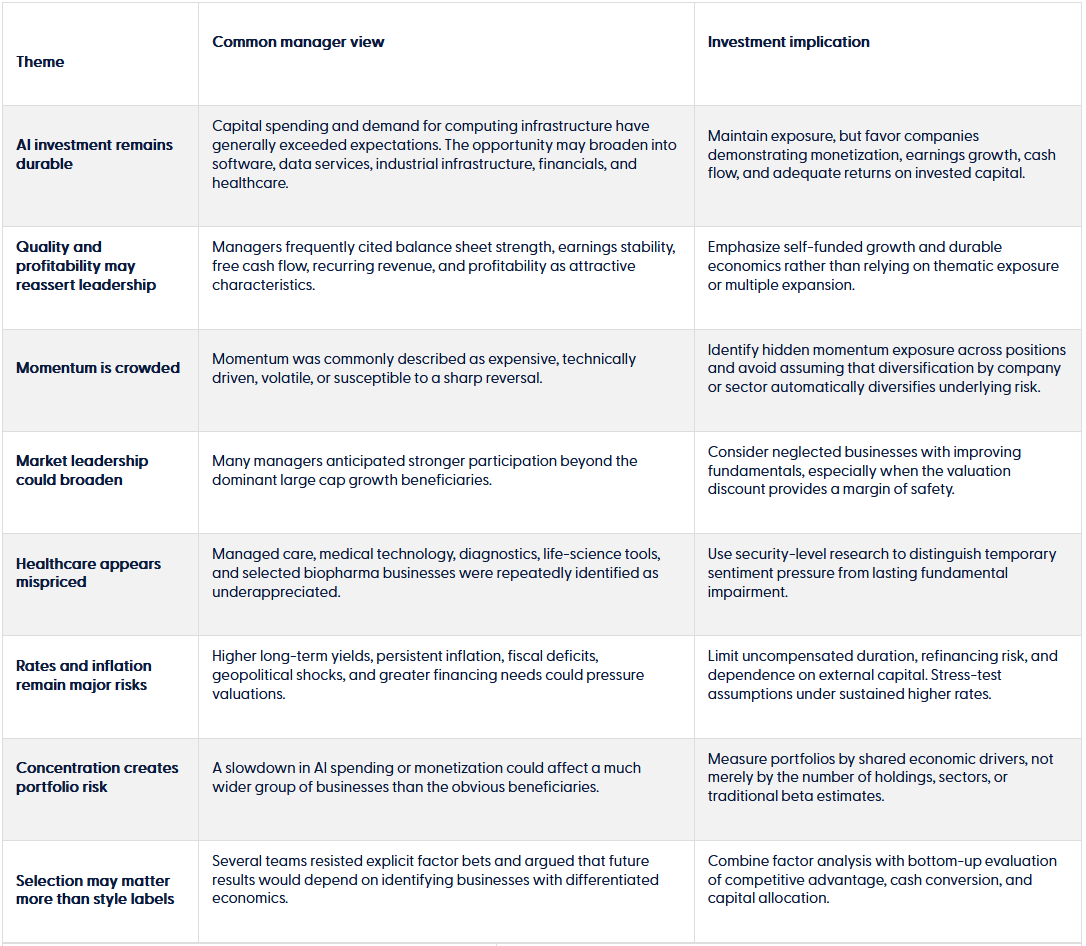
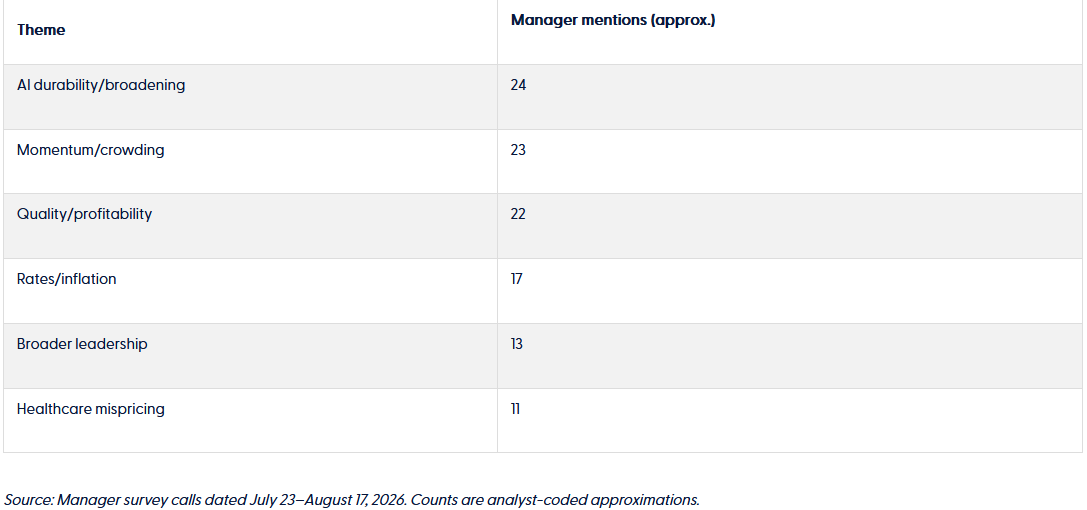
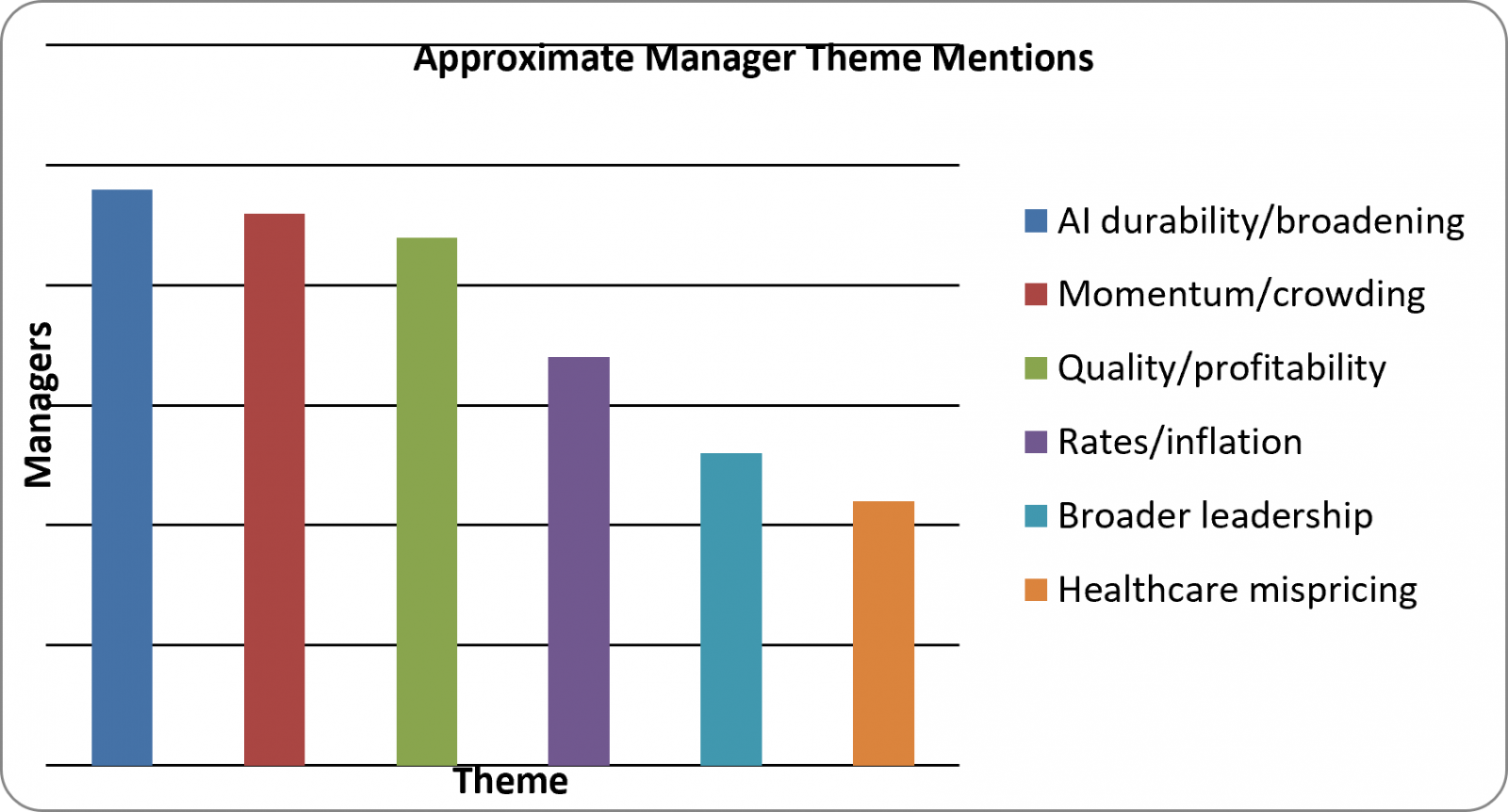
A striking divide emerged from this year’s midyear manager conversations: belief in the durability of artificial intelligence (AI) investment was widespread, yet confidence in how the gains would be distributed was anything but uniform. That tension matters because it creates a practical road map for investors: participate in durable growth, but demand evidence of cash generation, balance sheet strength, and improving returns on capital.
Across large cap growth, blend and value teams, the strongest common thesis was that AI investment remains a multiyear capital-spending cycle. Many teams said spending by large cloud platforms and demand for computing, memory, storage, power, and data infrastructure had exceeded earlier expectations. Several also argued that the opportunity is broadening beyond the initial hardware beneficiaries into software, data services, industrial infrastructure, and selected financial or healthcare businesses.
But agreement on the durability of spending did not mean agreement on valuation. Growth-oriented teams were generally more willing to accept premium valuations when supported by earnings revisions and persistent demand. Value and core teams were more likely to question whether every perceived beneficiary could earn an adequate return on their investment. The shared conclusion was not that the theme was ending. It was that the next phase may reward selectivity more than simple exposure.
Shifting Focus to the Forces Behind Market Returns
That distinction is central to the emerging factor debate. Momentum was the factor most often described as expensive, crowded, or vulnerable to reversal. Beta was also treated cautiously, especially when traditional risk measures may be capturing concentrated thematic exposure rather than broad market sensitivity. In contrast, quality, profitability, free cash flow, earnings stability, and valuation were repeatedly identified as attractive or likely sources of future alpha.
Quality, however, did not mean the same thing to every team. For some, quality meant durable revenue, stable earnings, and strong returns on invested capital. For others, it meant balance sheet strength, recurring cash flows, or the ability to self-fund investment. This variation is useful. It suggests that investors should avoid relying on a single backward-looking factor score and instead test whether reported quality is supported by business economics.
Broadening Participation: A Common View Among Managers
The second major theme was the possibility of broader market leadership. Numerous managers described an ideal performance environment as one in which returns spread across more sectors and companies rather than remaining concentrated in a small group. Healthcare, industrials, financials, life-science tools, and selected software businesses were among the most frequently cited areas where sentiment or valuation may not fully reflect fundamentals.
This broadening thesis has received some support from category performance. Through July 31, the Russell 1000 Value Index returned 20.7% year to date, versus 0.1% for the Russell 1000 Growth Index, according to FTSE Russell. By September 2, the Russell 1000 Growth Index had gained 2.95% over one month, indicating a rebound after many late-July growth calls. The evidence therefore supports managers who emphasize value leadership, broader participation, and the potential for momentum reversals, while also showing that growth leadership can recover quickly. Because individual calls occurred on different dates and complete daily total-return series were not available for every date, this is a category-level directional check rather than a manager scorecard.
Persistent Interest Rates and Renewed Inflation Emerged as the Most Common Risks
Teams linked that risk to fiscal deficits, energy shocks, geopolitical conflict, and the financing needs created by heavy capital spending. Several noted that rising long-term yields could pressure long-duration assets even if earnings remain resilient. Others focused on liquidity, leverage, and the market’s ability to absorb debt or equity issuance.
The next cluster of concerns involved concentration and crowding. Managers worried that a pause in capital spending, slower monetization, or a change in technical positioning could have effects far beyond the initial beneficiaries. Some also questioned whether beta and momentum had become overlapping expressions of the same dominant theme. This is an important portfolio-construction warning: diversification by name or sector may offer less risk mitigation if the underlying economic driver is shared.
Beyond the Common Themes, Several Outliers Were Worth Highlighting
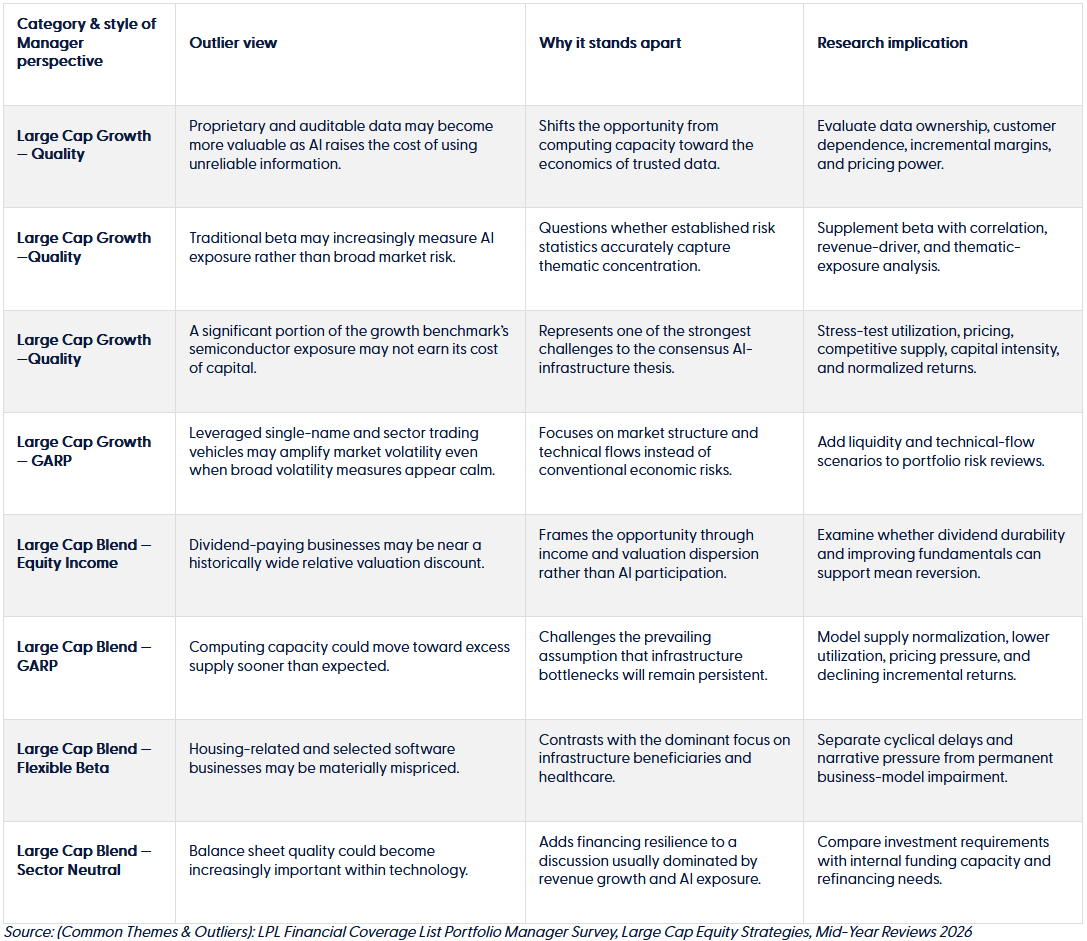
Several outliers sharpened the debate. One growth team argued that proprietary data may appreciate in value because reliable inputs become more important as AI adoption expands. Another warned that reported cash flow can be misleading in both directions, overstating temporary beneficiaries while understating companies investing for a durable advantage. A contrarian growth team argued that much of the semiconductor complex may not earn its cost of capital. Elsewhere, managers identified dividend yields, low volatility, value spreads, life-science tools, housing, and onshoring as less crowded opportunities.
What Received Less Attention May Be Just as Important
Few teams offered a detailed framework for regulatory costs, cybersecurity failures, grid interconnection delays, water constraints, accounting comparability, tax policy, or the second-order effect of automation on aggregate wages and demand. Supply-chain geographic concentration came up through Taiwan’s risk, but managers rarely connected it to explicit contingency planning. These omissions do not prove that the risks were ignored internally, but they were not prominent in the responses.
From Insights to Action: Applying Portfolio Manager Perspectives
A practical investment use case is to organize due diligence around three sleeves. The first is known compounders with visible earnings, cash conversion, and return on capital. The second is underappreciated beneficiaries where fundamentals are improving but narratives remain impaired, such as selected healthcare, industrial, financial, data, and software businesses. The third is portfolio ballast, emphasizing valuation discipline, low volatility, dividend growth, or lower beta where appropriate.
Within each sleeve, investors can ask four questions. Is demand durable without perpetual multiple expansion? Can investment be funded internally? Are returns on capital improving or merely promised? Does the position diversify the portfolio’s underlying economic drivers? These questions translate managers’ common views into a repeatable research process.
The midyear message is not a simple choice between growth and value. It is a call to separate durable economics from crowded narratives. AI investment may remain powerful, but the distribution of returns is likely to become more selective. If leadership broadens and rates remain volatile, portfolios built around quality, cash flow, valuation discipline, and differentiated sources of earnings may be better positioned for the next phase.
Common Themes
Outliers
Methodology: Identifying Key Risks and Opportunities
To identify the most prominent risks and opportunity sets across our firm’s internal Coverage List, we conducted structured interviews with nearly 40 portfolio management teams spanning mutual funds, ETFs, and SMAs. Each team was asked the same eight survey questions, ensuring consistency of inputs and comparability across strategies, vehicles, and investment styles.
Responses were first reviewed and normalized to account for differences in terminology and communication styles. Qualitative answers were then coded into thematic categories, allowing us to assess areas of convergence and divergence across managers. Themes that appeared repeatedly across multiple teams, particularly when supported by strong convictions or detailed rationale, were categorized as common views. Conversely, perspectives that meaningfully deviated from the broader sample, either in direction, magnitude, or underlying assumptions, were flagged as outliers.
To differentiate risks from opportunities, each theme was evaluated through a forward‑looking lens, considering how widely held assumptions, positioning, or macro and fundamental dependencies could influence future outcomes. Particular attention was paid to areas where consensus appeared strong but underlying conditions could change, as these scenarios may introduce asymmetric risk. Similarly, underappreciated or less crowded views — especially those supported by clear catalysts or structural trends — were evaluated as potential sources of opportunity.
This process resulted in a consolidated framework that reflects not only what portfolio managers are collectively emphasizing today, but also where expectations may be stretched, narratives overly aligned, or convictions unevenly distributed. This report summarizes the key insights derived from this analysis, organized around the eight survey questions.
- Important Disclosures
- This material is for general information only and is not intended to provide specific advice or recommendations for any individual. There is no assurance that the views or strategies discussed are suitable for all investors. To determine which investment(s) may be appropriate for you, please consult your financial professional prior to investing.
- Investing involves risks including possible loss of principal. No investment strategy or risk management technique can guarantee return or eliminate risk.
- Indexes are unmanaged and cannot be invested into directly. Index performance is not indicative of the performance of any investment and does not reflect fees, expenses, or sales charges. All performance referenced is historical and is no guarantee of future results.
- This material was prepared by LPL Financial, LLC. All information is believed to be from reliable sources; however LPL Financial makes no representation as to its completeness or accuracy.
- Unless otherwise stated LPL Financial and the third party persons and firms mentioned are not affiliates of each other and make no representation with respect to each other. Any company names noted herein are for educational purposes only and not an indication of trading intent or a solicitation of their products or services.
- Asset Class Disclosures –
- International investing involves special risks such as currency fluctuation and political instability and may not be suitable for all investors. These risks are often heightened for investments in emerging markets.
- Bonds are subject to market and interest rate risk if sold prior to maturity.
- Municipal bonds are subject and market and interest rate risk and potentially capital gains tax if sold prior to maturity. Interest income may be subject to the alternative minimum tax. Municipal bonds are federally tax-free but other state and local taxes may apply.
- Preferred stock dividends are paid at the discretion of the issuing company. Preferred stocks are subject to interest rate and credit risk. They may be subject to a call features.
- Alternative investments may not be suitable for all investors and involve special risks such as leveraging the investment, potential adverse market forces, regulatory changes and potentially illiquidity. The strategies employed in the management of alternative investments may accelerate the velocity of potential losses.
- Mortgage backed securities are subject to credit, default, prepayment, extension, market and interest rate risk.
- High yield/junk bonds (grade BB or below) are below investment grade securities, and are subject to higher interest rate, credit, and liquidity risks than those graded BBB and above. They generally should be part of a diversified portfolio for sophisticated investors.
- Precious metal investing involves greater fluctuation and potential for losses.
- The fast price swings of commodities will result in significant volatility in an investor's holdings.
- This research material has been prepared by LPL Financial LLC.
- Not Insured by FDIC/NCUA or Any Other Government Agency | Not Bank/Credit Union Deposits or Obligations | Not Bank/Credit Union Guaranteed | May Lose Value
- For Public Use – Tracking: #1175789