
9.23.26 Uncertainty Evolves. Sound Portfolio Construction Endures
Back in March, we examined how well-anchored portfolio construction, supported by LPL Research’s strategic asset allocation (SAA), could help weather your portfolio for the long-term in “Finding Portfolio Resilience in Uncertain Times.” In that market article, we discussed our SAA and the benefits of playing an active role in long-term portfolio construction. Six months later, in September 2026, we could run that same exercise, only the headlines look a little different this time. Now it reads more like “Fed Hikes Rates for the First Time Since 2023” and “Oil Tops $100 a Barrel as Middle East Tensions Persist.” Then the very next day, “Stocks Get Tech Lift as Oil Falls on U.S.-Iran Hopes.” The uncertainty we discussed in March never fully cleared. It simply evolved, which strengthens the case for durable, well-rounded, strategically aligned portfolios.
As the third quarter wraps up over the next week, and we round the corner to the home stretch of the year, we thought it would be beneficial to revisit how some of those long-term SAA decisions have fared in Q3, addressing the same asset categories we explored in March.
Alternative Investments
Our case for diversifying with liquid alternatives and uncorrelated return streams remains intact and, in our view, is strengthened by a renewed hiking cycle. The macroeconomic backdrop for alternative strategies has become increasingly supportive, in our view. Persistently elevated interest rates, heightened policy uncertainty, and a more hawkish policy response have contributed to greater market dispersion, creating a potentially favorable environment for liquid alternative strategies designed to capitalize on such opportunities.
Discretionary global macro funds are built to capitalize on shifts like the one we just saw from the Fed. Managed futures strategies have been a standout quarter to date (QTD), benefiting from price trends that a change in policy direction and prolonged geopolitical unrest tend to create, whether in oil, the dollar, or interest rate futures. Multi-strategy vehicles that combine several of these approaches continue to offer a way to limit long-term capital deterioration when correlations between stocks and bonds rise, which is an initial risk a renewed hiking cycle can introduce. All of these strategies are highly speculative and may present significant risks, including liquidity risks.
From a portfolio management perspective, we tend to view our strategic overweight to alternative investments versus an underweight to U.S. Treasuries, as Treasuries are the primary funding source we used to build out the alternatives positions. The chart below highlights the strong relative strength QTD of those positions relative to their “funder," U.S. Treasuries.
Alternative Investment Index Returns vs. U.S. Treasuries
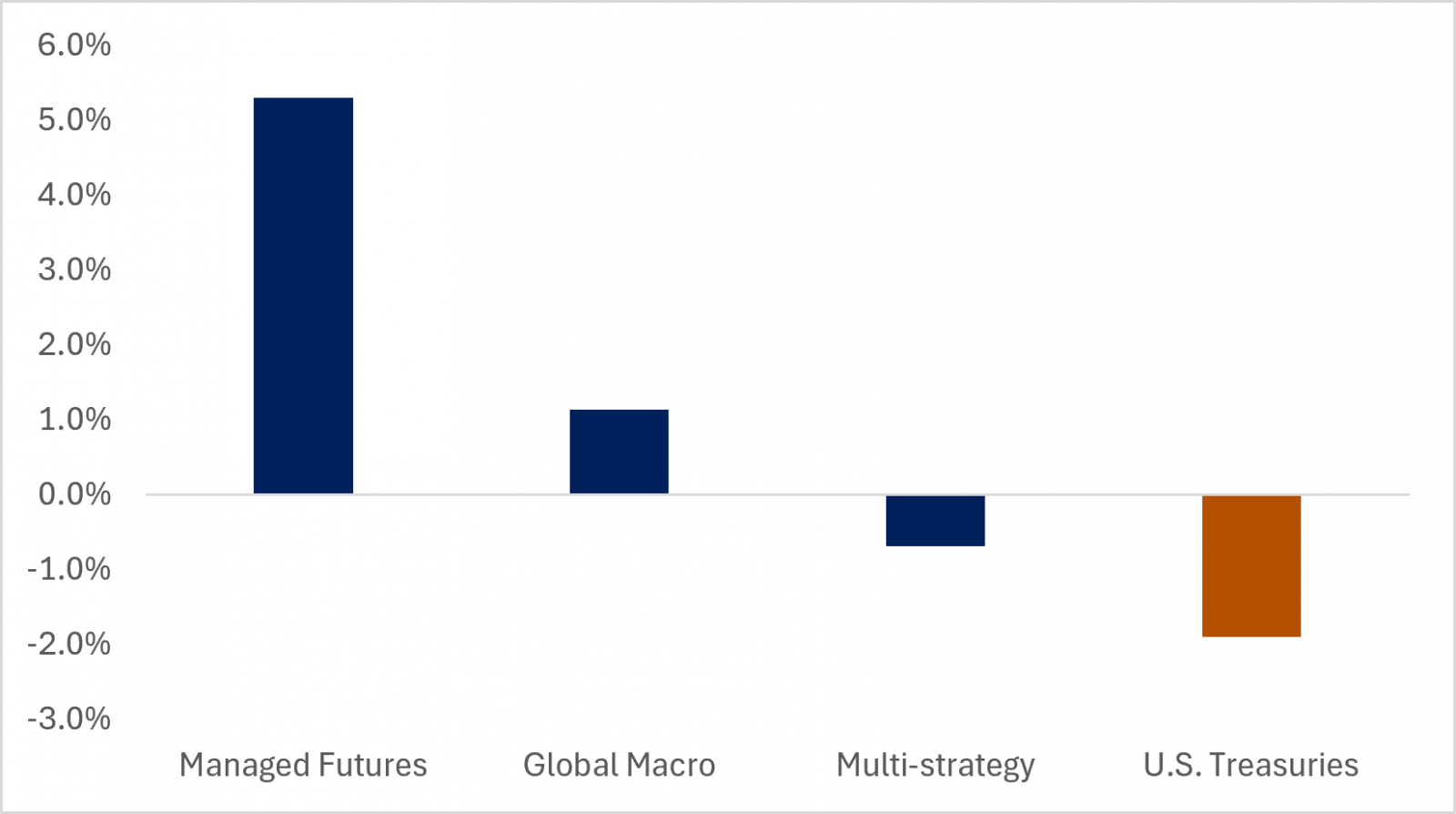
- Source: LPL Research, Bloomberg 09/18/26
- Disclosures: Indexes are unmanaged and cannot be invested in directly. Past performance is no guarantee of future results.
- Managed Futures: HFRX Macro: Systematic Diversified CTA Index; Global Macro: HFRX Macro/CTA Index; Multi-Strategy: HFRX Global Hedge Fund (USD) Index; U.S. Treasuries: Bloomberg U.S. Treasury Index
Treasury Inflation-Protected Securities (TIPS)
Our longer-term strategic view at the start of the year was that the market was underpricing inflation risk; the events of the past six months have only reinforced that thesis. Progress on the inflation front has been delayed due to the Mideast conflict. Elevated transportation expenses, ongoing supply chain disruptions, and renewed strains within energy markets have complicated the inflation outlook, contributing to price pressures that have proved more persistent than many anticipated. Consequently, the path toward disinflation has been slower than expected. Favoring short-duration TIPS also reduces interest rate sensitivity while preserving the inflation protection benefit, an important distinction now that longer-dated yields have become considerably more volatile. As referenced in the “Short Duration TIPS vs. Nominal U.S. Treasuries” chart, we proxy our short-duration TIPS with the Bloomberg U.S. Treasury TIPS 0-5 Year Index, which has traded roughly between +0.5% and -0.5% for most of the quarter, while the longer-dated nominal Bloomberg U.S. Treasury Total Return Index has fallen about 1.9% QTD through September 18.
Short-Duration TIPS vs. Nominal U.S. Treasuries
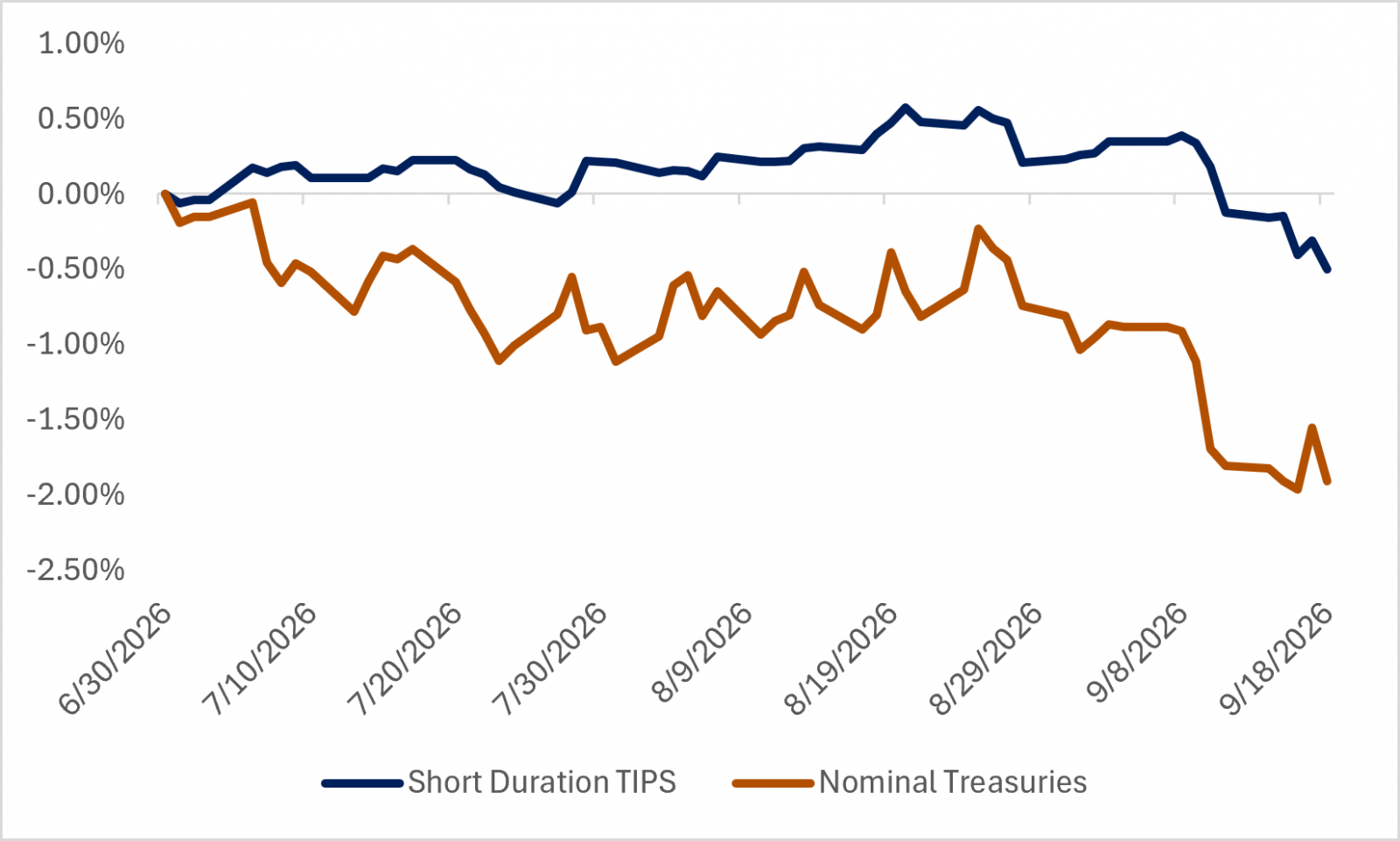
- Source: LPL Research, Bloomberg 09/18/26
- Disclosures: Indexes are unmanaged and cannot be invested in directly. Past performance is no guarantee of future results.
- Short-Duration TIPS: Bloomberg U.S. Treasury TIPS 0-5 year Index; Nominal Treasuries: Bloomberg U.S. Treasury Total Return Index
Real Assets
Performance of our real asset exposure to commodities and global listed infrastructure has been mixed in Q3. Commodities have performed well, posting an 18% gain in the oil-complex-dominated Bloomberg Commodity Index through September 18, as geopolitical pressures and supply disruptions have yet to abate. Global listed infrastructure came under moderate pressure during the quarter as the S&P Global Infrastructure Index sold off about 5% through September 18. While power-demand growth and the capital spending pipeline remain strong, a backup in 10-year U.S. Treasury yields challenged these longer-duration assets. Nonetheless, over long-term horizons, as our SAA is constructed, we believe the inflation pass-through benefits and stable yields remain attractive.
The Bottom Line
Six months ago, we said that time can be an investor’s best friend, and that well-constructed portfolios are built to withstand periods of geopolitical stress. That statement holds up well today, even as the nature of the stress is ever evolving. Hopefully, this has helped lead to more confidence in positioning. The underlying discipline required by investors has not changed. Stay anchored in long-term fundamentals, maintain a diversified asset allocation, and resist the urge to make asset-allocation decisions based on any single headline.
- Additional Disclosure: Managed futures are speculative, use significant leverage, may carry substantial charges, and should only be considered suitable for the risk-capital portion of an investor's portfolio.
- Important Disclosures
- This material is for general information only and is not intended to provide specific advice or recommendations for any individual. There is no assurance that the views or strategies discussed are suitable for all investors. To determine which investment(s) may be appropriate for you, please consult your financial professional prior to investing.
- Investing involves risks including possible loss of principal. No investment strategy or risk management technique can guarantee return or eliminate risk.
- Indexes are unmanaged and cannot be invested into directly. Index performance is not indicative of the performance of any investment and does not reflect fees, expenses, or sales charges. All performance referenced is historical and is no guarantee of future results.
- This material was prepared by LPL Financial, LLC. All information is believed to be from reliable sources; however LPL Financial makes no representation as to its completeness or accuracy.
- Unless otherwise stated LPL Financial and the third party persons and firms mentioned are not affiliates of each other and make no representation with respect to each other. Any company names noted herein are for educational purposes only and not an indication of trading intent or a solicitation of their products or services.
- Asset Class Disclosures –
- International investing involves special risks such as currency fluctuation and political instability and may not be suitable for all investors. These risks are often heightened for investments in emerging markets.
- Bonds are subject to market and interest rate risk if sold prior to maturity.
- Municipal bonds are subject and market and interest rate risk and potentially capital gains tax if sold prior to maturity. Interest income may be subject to the alternative minimum tax. Municipal bonds are federally tax-free but other state and local taxes may apply.
- Preferred stock dividends are paid at the discretion of the issuing company. Preferred stocks are subject to interest rate and credit risk. They may be subject to a call features.
- Alternative investments may not be suitable for all investors and involve special risks such as leveraging the investment, potential adverse market forces, regulatory changes and potentially illiquidity. The strategies employed in the management of alternative investments may accelerate the velocity of potential losses.
- Mortgage backed securities are subject to credit, default, prepayment, extension, market and interest rate risk.
- High yield/junk bonds (grade BB or below) are below investment grade securities, and are subject to higher interest rate, credit, and liquidity risks than those graded BBB and above. They generally should be part of a diversified portfolio for sophisticated investors.
- Precious metal investing involves greater fluctuation and potential for losses.
- The fast price swings of commodities will result in significant volatility in an investor's holdings.
- This research material has been prepared by LPL Financial LLC.
- Not Insured by FDIC/NCUA or Any Other Government Agency | Not Bank/Credit Union Deposits or Obligations | Not Bank/Credit Union Guaranteed | May Lose Value
- For Public Use – Tracking: #1179778